Klimaschutz
Aktuelles
Stadt Schwandorf startet Bürgerbeteiligung zur kommunalen Wärmeplanung
Öffentliche Informationsveranstaltung am 28. April 2026
Wie soll die Wärmeversorgung in Schwandorf in Zukunft aussehen? Mit dieser Frage beschäftigt sich die Stadt im Rahmen der kommunalen Wärmeplanung. Sie soll aufzeigen, wie die Wärmeversorgung in den kommenden Jahren klimafreundlich, bezahlbar und verlässlich gestaltet werden kann. Dabei geht es unter anderem um Themen wie Nah- und Fernwärme, individuelle Heizlösungen und die zukünftige Entwicklung einzelner Stadtteile.
Die Stadt Schwandorf lädt die Bürgerinnen und Bürger jetzt ausdrücklich zur Mitwirkung an der Wärmeplanung ein. Zum Auftakt findet am Dienstag, den 28. April 2026, um 17.00 Uhr im Konrad-Max-Kunz-Saal der Oberpfalzhalle (Schwimmbadstraße 4, 92421 Schwandorf) eine öffentliche Informations- und Dialogveranstaltung statt. Im Mittelpunkt stehen Ziele, Ablauf und mögliche Lösungswege.
„Noch ist nichts entschieden. Uns ist wichtig, die Menschen in Schwandorf frühzeitig einzubinden und ihre Fragen, Sorgen und Ideen aufzunehmen“, erklärt Maria Pushkareva, Klimaschutzmanagerin der Stadt Schwandorf.
Die Veranstaltung richtet sich ausdrücklich an alle interessierten Bürgerinnen und Bürger. Neben kurzen, verständlichen Informationen gibt es Möglichkeiten zum Austausch und zur Rückmeldung. Bei einer Brotzeit kann zudem direkt mit Vertreterinnen und Vertretern der Stadt sowie Fachleuten ins Gespräch gekommen werden.
Der Eintritt ist frei, eine Anmeldung ist nicht notwendig. Die Rückmeldungen fließen in den weiteren Planungsprozess ein.
Neue Klimaschutzmanagerin
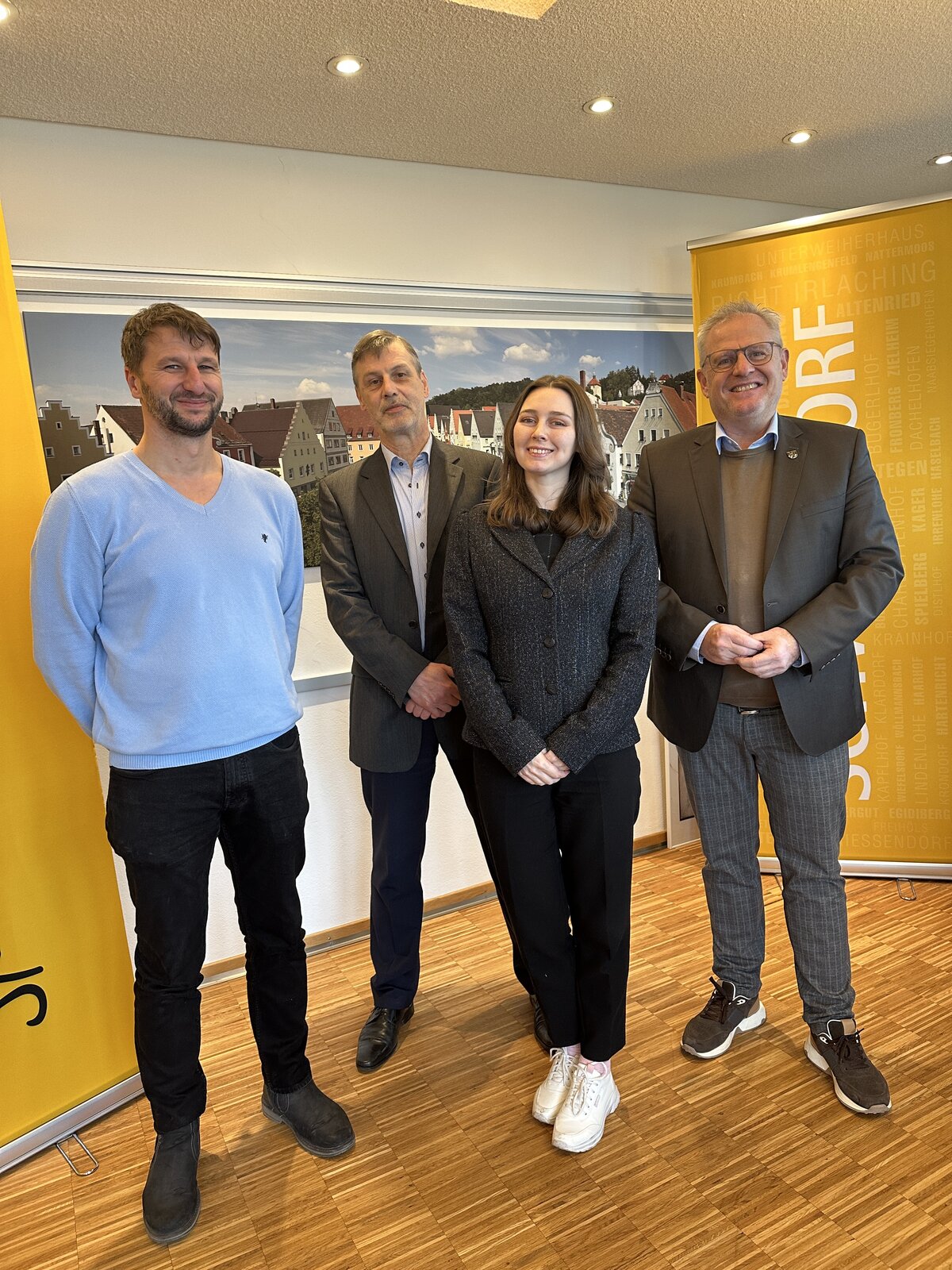
Im November 2025 wurde die neue Klimaschutzmanagerin der Stadt Schwandorf, Maria Pushkareva, von Oberbürgermeister Andreas Feller begrüßt.
 Lara Schmaus © Stadt Schwandorf
Nachhaltigkeit und Klimaschutz
Der Klimawandel zählt zu den zentralen Herausforderungen unserer Zeit. Steigende globale Temperaturen, häufigere Extremwetterereignisse und Veränderungen von Ökosystemen zeigen bereits heute deutlich die Auswirkungen. Hauptursache ist der Ausstoß von Treibhausgasen wie Kohlendioxid (CO₂), Methan (CH₄) und Lachgas (N₂O), insbesondere durch die Nutzung fossiler Energieträger. Die Folgen betreffen Umwelt, Wirtschaft und Gesellschaft gleichermaßen und erfordern umfassende Maßnahmen auf allen Ebenen.
 © Ed Hawkins, National Centre for Atmospheric Science, University of Reading., National Centre for Atmospheric Science, UoR.
Nachhaltigkeit als Leitprinzip
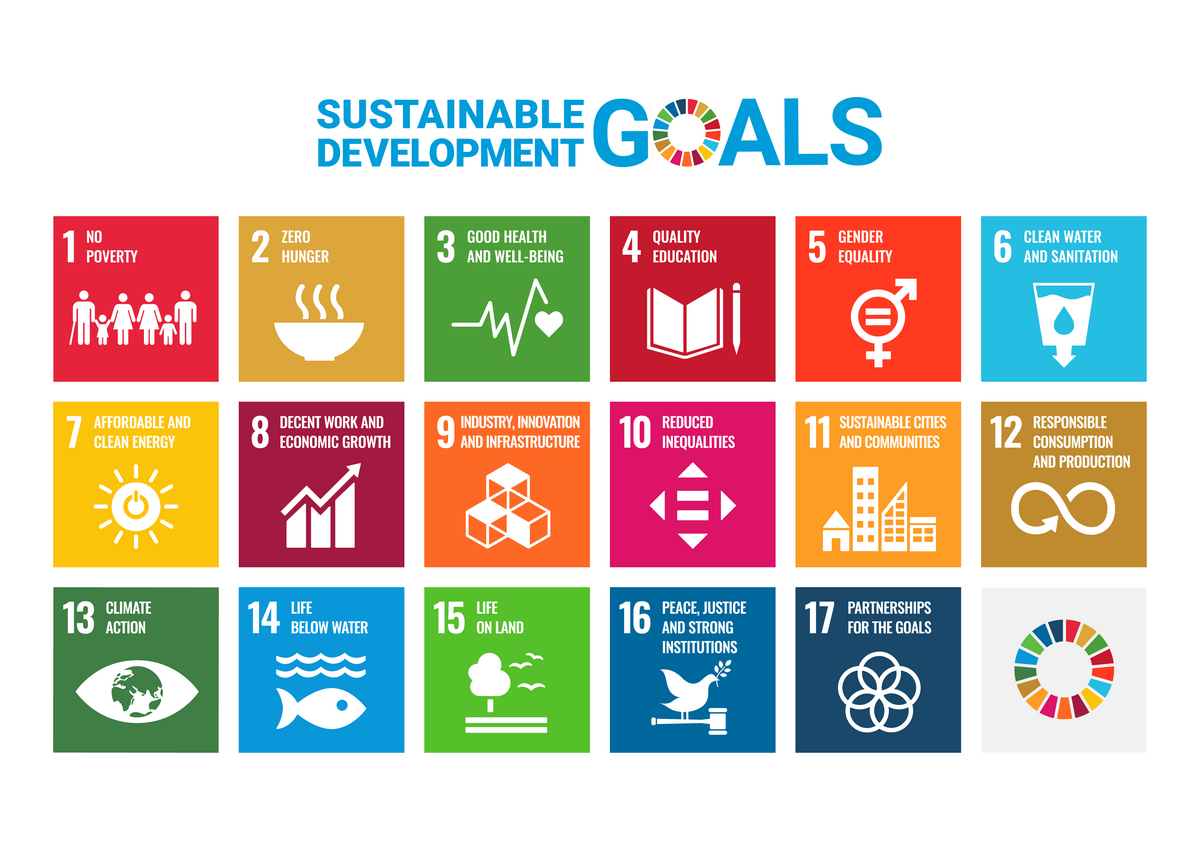
Nachhaltigkeit bedeutet, die Bedürfnisse der heutigen Generation zu erfüllen, ohne die Lebensgrundlagen zukünftiger Generationen zu gefährden. Dabei werden ökologische, wirtschaftliche und soziale Aspekte gemeinsam betrachtet. Die Nachhaltigkeitsziele der Vereinten Nationen (Sustainable Development Goals, SDGs) bilden hierfür einen wichtigen internationalen Rahmen. Sie verbinden Klimaschutz, nachhaltige Energieversorgung, Ressourcenschonung und soziale Gerechtigkeit.
 © https://www.un.org/sustainabledevelopment
Ein zentraler Bestandteil nachhaltiger Entwicklung ist der Klimaschutz. Ziel ist es, Treibhausgasemissionen deutlich zu reduzieren und Energiesysteme schrittweise auf erneuerbare Energien umzustellen. Wichtige Maßnahmen sind der Ausbau von Wind- und Solarenergie, die Steigerung der Energieeffizienz, nachhaltige Mobilität sowie ein verantwortungsvoller Umgang mit Ressourcen.
Klimapolitik auf internationaler, europäischer und nationaler Ebene
Der Klimaschutz ist eine globale Aufgabe, die nur durch internationale Zusammenarbeit wirksam umgesetzt werden kann. Ein zentraler Meilenstein ist das Pariser Klimaschutzabkommen, das die Begrenzung der Erderwärmung auf deutlich unter zwei Grad Celsius und möglichst 1,5 Grad vorsieht.
Auf europäischer Ebene verfolgt die Europäische Union mit dem European Green Deal das Ziel, bis 2050 klimaneutral zu werden. Deutschland hat sich zum Ziel gesetzt, bereits bis 2045 Treibhausgasneutralität zu erreichen. Das Bundes-Klimaschutzgesetz legt dafür verbindliche Emissionsziele für verschiedene Sektoren fest.
Diese übergeordneten Ziele werden durch konkrete Strategien und Maßnahmen in Bereichen wie Energieversorgung, Gebäude, Verkehr und Industrie umgesetzt.
Stadtklima und Klimaanpassung
Der Klimawandel wirkt sich besonders stark auf Städte aus. Dicht bebaute und versiegelte Flächen speichern Wärme und führen zu sogenannten Hitzeinseln, während gleichzeitig Extremwetterereignisse wie Starkregen oder längere Trockenperioden zunehmen. Diese Entwicklungen stellen neue Anforderungen an Gesundheit, Infrastruktur und Stadtplanung.
Neben dem Klimaschutz gewinnt daher die Klimaanpassung zunehmend an Bedeutung. Ziel ist es, Städte widerstandsfähiger gegenüber den Folgen des Klimawandels zu machen. Eine wichtige Rolle spielen dabei Grünflächen, Gewässer und unversiegelte Böden, da sie zur Kühlung beitragen, den Luftaustausch fördern und Wasser aufnehmen können.
Zu den zentralen Maßnahmen gehören die Begrünung von Gebäuden und öffentlichen Räumen, der Erhalt und Ausbau von Grünflächen sowie die Entsiegelung von Flächen. Auch Maßnahmen zur Regenwasserrückhaltung helfen, die Auswirkungen von Starkregen zu reduzieren.
Lebensqualität und nachhaltige Stadtentwicklung
Maßnahmen zum Klimaschutz und zur Klimaanpassung tragen nicht nur zum Umweltschutz bei, sondern verbessern auch die Lebensqualität in Städten. Grünflächen fördern Erholung und Gesundheit, verbessern die Luftqualität und stärken die biologische Vielfalt.
Eine vorausschauende und integrierte Stadtplanung ist daher entscheidend, um Städte langfristig lebenswert, klimafreundlich und resilient zu gestalten. Nachhaltige Entwicklung, Klimaschutz und Klimaanpassung sind eng miteinander verknüpft und bilden gemeinsam die Grundlage für eine zukunftsfähige Stadtentwicklung.
Ziele und Grundlagen der Klimaschutzpolitik in Schwandorf
Die Große Kreisstadt Schwandorf verfolgt das Ziel, einen aktiven Beitrag zum Klimaschutz zu leisten und die lokale Entwicklung langfristig nachhaltig und zukunftsfähig zu gestalten. Grundlage der kommunalen Klimaschutzpolitik ist das Bestreben, Treibhausgasemissionen zu reduzieren, Energie effizienter zu nutzen und den Anteil erneuerbarer Energien in der Energieversorgung kontinuierlich zu erhöhen.
Dabei orientiert sich die Stadt an den übergeordneten Zielen der internationalen, europäischen und nationalen Klimapolitik. Insbesondere die Vorgaben des Pariser Klimaschutzabkommens, die Klimaschutzziele der Europäischen Union sowie die nationalen Ziele Deutschlands bilden einen wichtigen Rahmen für die kommunale Planung und Umsetzung von Klimaschutzmaßnahmen.
Ein zentrales Handlungsfeld ist die Energie- und Wärmeversorgung im Stadtgebiet. Durch strategische Planungsinstrumente wie die kommunale Wärmeplanung werden bestehende Strukturen analysiert und Perspektiven für eine klimafreundliche Energieversorgung entwickelt. Ziel ist es, langfristig tragfähige Lösungen für eine sichere, bezahlbare und möglichst emissionsarme Wärmeversorgung zu schaffen.
Darüber hinaus spielen auch weitere Bereiche eine wichtige Rolle für den lokalen Klimaschutz. Dazu gehören eine energieeffiziente Entwicklung von Gebäuden, der Ausbau erneuerbarer Energien, nachhaltige Mobilitätsangebote sowie eine ressourcenschonende Stadtentwicklung. Durch die Kombination verschiedener Maßnahmen kann der Energieverbrauch reduziert und die Klimawirkung kommunaler Aktivitäten verringert werden.
Die Klimaschutzpolitik der Stadt Schwandorf versteht sich dabei als langfristiger Prozess. Neben technischen und infrastrukturellen Maßnahmen sind auch Information, Beratung und die Einbindung von Bürgerinnen und Bürgern, Unternehmen und lokalen Akteuren wichtige Bestandteile. Gemeinsam soll so der Weg zu einer klimafreundlichen und nachhaltigen Stadtentwicklung gestaltet werden.
Integriertes Klimaschutzkonzept
Am 30.10.2023 wurde im Stadtrat die Umsetzung des Klimaschutzkonzepts gebilligt:
Die beinhalteten Klimaschutzmaßnahmen werden sukzessive, im Rahmen der finanziellen Möglichkeiten und angepasst an die zukünftigen Entwicklungen, umgesetzt. Das durch Bundesmittel geförderte Klimaschutzmanagement steht der Stadt Schwandorf zur Verfügung.
I Bestandsaufnahme Energie- und Treibhausgasbilanz
Erfassung aller relevanter Energieverbräuche im Bereich Strom, Wärme und Brennstoffe in Schwandorf. Ermittlung der Zusammensetzung von Strom- und Wärmeerzeugung. Aufteilung in Verbrauchergruppen: private Haushalte, kommunale Gebäude, Wirtschaft und Verkehr.
Berechnung der Treibhausgasbilanz aus den Energieverbräuchen. Wie viel Tonnen Treibhausgase verursacht Schwandorf und jeder Einwohner pro Jahr?
II Potentialanalyse und Szenarien
Basierend auf der Energie- und Treibhausgasbilanz, den zur Verfügung stehende Flächen und örtlichen Gegebenheiten in Schwandorf, können theoretische Entwicklungspotentiale für den Ausbau erneuerbarer Energien und Einsparpotential beim Energieverbrauch ermittelt werden. Zusätzlich werden Klimaschutzszenarien entwickelt, die notwendige Entwicklungspfade zum Erreichen der übergeordneten politischen Zielsetzungen auf dem Weg zur Treibhausgasneutralität aufzeigen.
III Klimaschutzmaßnahmen
Um die gesetzlichen Vorgaben auf Bundes- und Landesebene zu erreichen, bedarf es konkreter Handlungsschritte. Im Rahmen der Fertigstellung des Klimaschutzkonzept können die entwickelten Maßnahmen durch den Stadtrat beschlossen und damit deren langfristige Umsetzung in die Wege geleitet werden.
Die Handlungsfelder der Maßnahmen umfassen dabei:
IV Verstetigung und Controlling
Nur wenn Klimaschutz langfristig in Schwandorf verankert wird, können die notwendigen Maßnahmen und Prozesse im Bereich der Energiewende und beim Klimaschutz in den kommenden Jahren auch umgesetzt werden.
Gleichzeitig muss Klimaschutz messbar sein und dies erfordert eine kontinuierliche Kontrolle der Vorschritte und Überwachung der Treibhausgasemissionen. Nur so kann sichergestellt werden, dass Klimaschutzmaßnahmen zielführend sind und Treibhausgase tatsächlich eingespart werden.
Perspektive
Die Stadt Schwandorf steht – wie viele Kommunen – vor der Aufgabe, die Folgen des Klimawandels aktiv zu bewältigen und gleichzeitig die Ursachen weiter zu reduzieren. Zukünftig wird es darauf ankommen, Klimaschutz (Minderung von Treibhausgasemissionen) und Klimaanpassung noch stärker miteinander zu verzahnen. Mit der kommunalen Wärmeplanung, dem Ausbau erneuerbarer Energien und der Steigerung der Energieeffizienz werden wichtige Grundlagen für eine klimafreundliche Energieversorgung geschaffen. Gleichzeitig gewinnen Maßnahmen zur Anpassung an den Klimawandel zunehmend an Bedeutung. Dazu zählen insbesondere der Erhalt und Ausbau von Grünflächen, die Reduzierung von Hitzeinseln, eine klimaangepasste Stadtentwicklung sowie ein nachhaltiger Umgang mit Wasser bei Starkregenereignissen und Trockenperioden. Durch eine vorausschauende Planung und die konsequente Weiterentwicklung bestehender Strategien kann Schwandorf langfristig eine widerstandsfähige, klimafreundliche und lebenswerte Stadt bleiben.
Wärmewende
Die Wärmewende ist ein zentraler Bestandteil der lokalen Klimaschutzstrategie. Ein großer Teil des Energieverbrauchs und der Treibhausgasemissionen entsteht im Bereich der Wärmeversorgung von Gebäuden. Ziel ist es daher, die Wärmeversorgung in Schwandorf langfristig klimafreundlicher, effizienter und zukunftssicher zu gestalten.
Eine wichtige Grundlage dafür bildet die kommunale Wärmeplanung, die derzeit für die Stadt Schwandorf erarbeitet wird. Im Rahmen dieses Prozesses werden die bestehenden Strukturen der Wärmeversorgung analysiert und mögliche Potenziale für erneuerbare Energien sowie effiziente Versorgungsformen untersucht. Dazu gehören beispielsweise Möglichkeiten für Wärmenetze, der Einsatz erneuerbarer Wärmequellen sowie dezentrale Lösungen für einzelne Gebäude oder Ortsteile.
Die kommunale Wärmeplanung soll aufzeigen, welche Versorgungsoptionen in verschiedenen Bereichen des Stadtgebiets langfristig sinnvoll und wirtschaftlich umsetzbar sein können. Auf dieser Basis können zukünftige Investitionen und Maßnahmen gezielter geplant werden. Langfristig verfolgt die Stadt das Ziel, den Anteil erneuerbarer Energien in der Wärmeversorgung deutlich zu erhöhen und den Einsatz fossiler Energieträger schrittweise zu reduzieren.
Energiewende
Neben der Wärmeversorgung umfasst die Energiewende auch die Umstellung der Stromversorgung auf erneuerbare Energien sowie eine effizientere Nutzung von Energie insgesamt. Ziel ist es, den Energieverbrauch zu senken und gleichzeitig den Anteil erneuerbarer Energien kontinuierlich auszubauen.
Dazu gehört unter anderem der Ausbau von Photovoltaikanlagen, die Nutzung regionaler Energiepotenziale sowie die Förderung energieeffizienter Technologien. Auch die Verbindung verschiedener Bereiche wie Strom, Wärme und Mobilität gewinnt zunehmend an Bedeutung.
Durch eine nachhaltige Energieversorgung kann die Stadt Schwandorf langfristig unabhängiger von fossilen Energieträgern werden und gleichzeitig einen wichtigen Beitrag zum Klimaschutz leisten. Der Stadtentwicklungsplan bildet hierfür eine strategische Grundlage und zeigt Perspektiven für eine zukunftsfähige und klimafreundliche Entwicklung der Stadt auf.
Wärmeplanung
Die kommunale Wärmeplanung ist ein zentrales Instrument, um die Wärmeversorgung langfristig klimafreundlich, effizient und zukunftssicher zu gestalten. Ziel der Wärmeplanung ist es, eine strategische Grundlage für die zukünftige Wärmeversorgung im Stadtgebiet zu schaffen und Wege aufzuzeigen, wie der Anteil erneuerbarer Energien erhöht und Treibhausgasemissionen reduziert werden können.
Im Rahmen der kommunalen Wärmeplanung wird die aktuelle Situation der Wärmeversorgung im Stadtgebiet umfassend analysiert. Dazu gehören unter anderem der Wärmebedarf von Gebäuden, die bestehenden Heizsysteme sowie vorhandene Energie- und Wärmenetze. Gleichzeitig werden Potenziale für erneuerbare Energien und alternative Wärmequellen untersucht.
Auf Basis dieser Analysen werden mögliche Entwicklungspfade für eine zukünftige Wärmeversorgung erarbeitet. Dabei wird geprüft, in welchen Bereichen beispielsweise der Ausbau von Wärmenetzen sinnvoll sein kann und wo eher dezentrale Lösungen für einzelne Gebäude oder Ortsteile in Betracht kommen. Ziel ist es, für unterschiedliche Gebiete geeignete und langfristig tragfähige Lösungen zu identifizieren.
Die kommunale Wärmeplanung dient dabei in erster Linie als strategisches Planungsinstrument. Sie trifft keine unmittelbaren Vorgaben für einzelne Gebäude oder Haushalte, sondern zeigt mögliche Perspektiven für die zukünftige Wärmeversorgung auf. Gleichzeitig schafft sie eine wichtige Grundlage für weitere Planungen, Investitionen und Entscheidungen von Stadt, Energieversorgern, Unternehmen und Bürgerinnen und Bürgern.
Weitere Informationen finden Sie hier:
Bürgerbeteiligung und Veranstaltungen
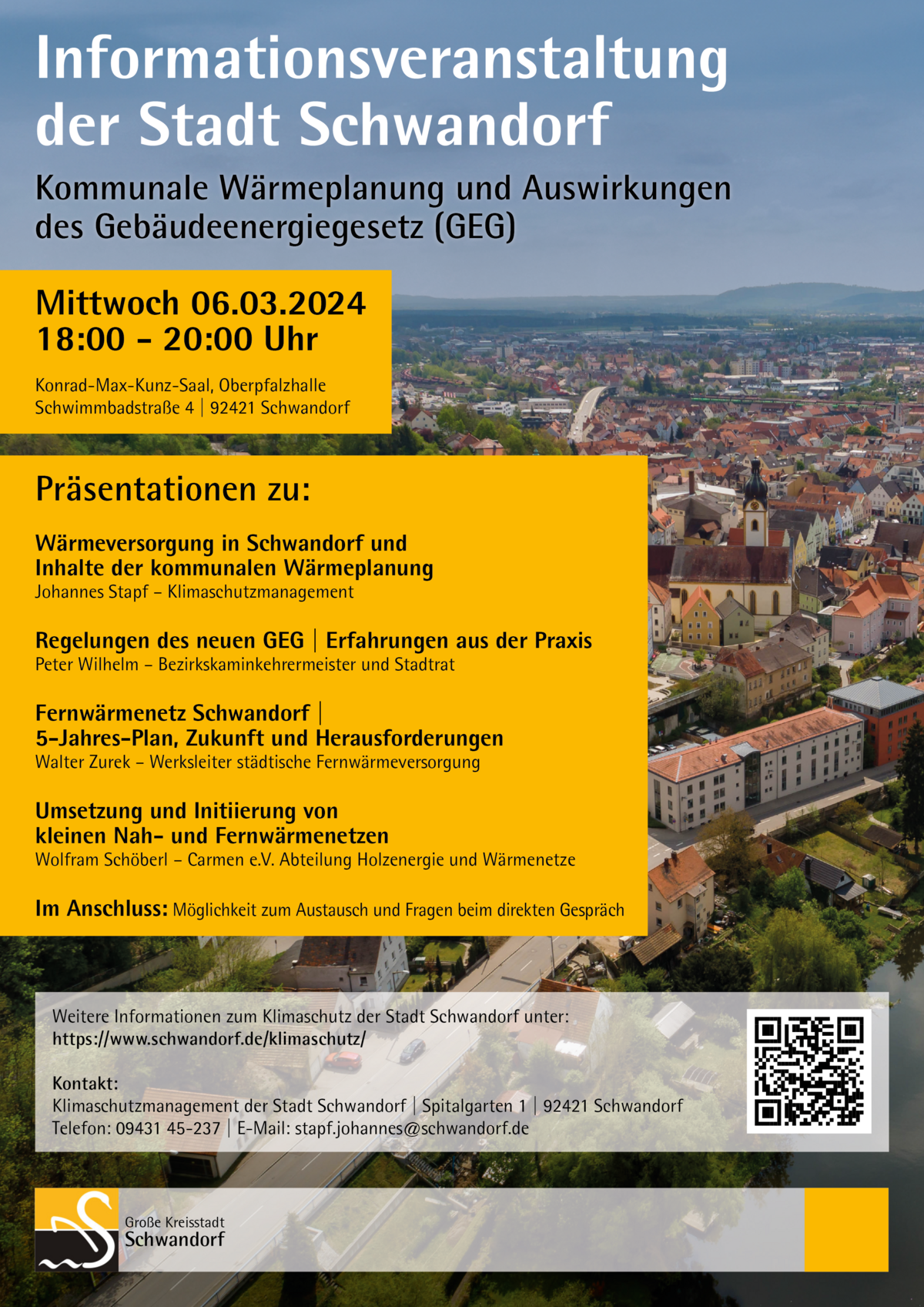
Informationsveranstaltung kommunale Wärmeplanung und GEG - 06.03.2024
 Die Grübeltäter GmbH © Die Grübeltäter GmbH
Im Oktober 2023 und Januar 2024 traten das novellierte Gebäudeenergiegesetz (GEG) und das neue Wärmeplanungsgesetz als auch in Kraft. Eine komplexe Verknüpfung beider Gesetze und komplizierte Vorgaben zu den verfügbaren Heizungslösungen haben zu einer großen Verunsicherung und vielen Fragen in der Bevölkerung geführt.
Um den Hauseigentümern der Stadt Schwandorf und allen Interessierten Informationen zu den neuen Regelungen dieser beiden Gesetze und geplanten Entwicklungen in der Stadt bereitzustellen, findet am Mittwoch den 6. März 2024 um 18:00 Uhr im Konrad-Max-Kunz Saal der Oberpfalzhalle, Schwimmbadstraße 4, 92421 Schwandorf eine Informationsveranstaltung statt.
Informative und praxisnahe Vorträge von Bezirkskaminkehrermeister Peter Wilhelm, Werksleiter der städtischen Fernwärme Walter Zurek, des Klimaschutzmanagements der Stadt Schwandorf und Wolfram Schöberl von der CARMEN e.V. werden einen Einblick in Themen wie die aktuellen Wärmeversorgung der Stadt Schwandorf und Inhalte der kommunalen Wärmeplanung, die geplante Entwicklung des städtischen Fernwärmenetzes, Erfahrungen aus der Heizungspraxis und Rat an Anlagenbetreiber bezüglich des GEG oder den möglichen Entwicklungen bei kleinen Biomasse-Nahwärmenetzen geben. Am Anschluss wird die Möglichkeit zum Austausch an Infoständen bestehen.
Die Bürgerinnen und Bürger der Stadt Schwandorf sind hierzu herzlich eingeladen.
Bürgerversammlung zum Thema Windenergie - 28.02.2024
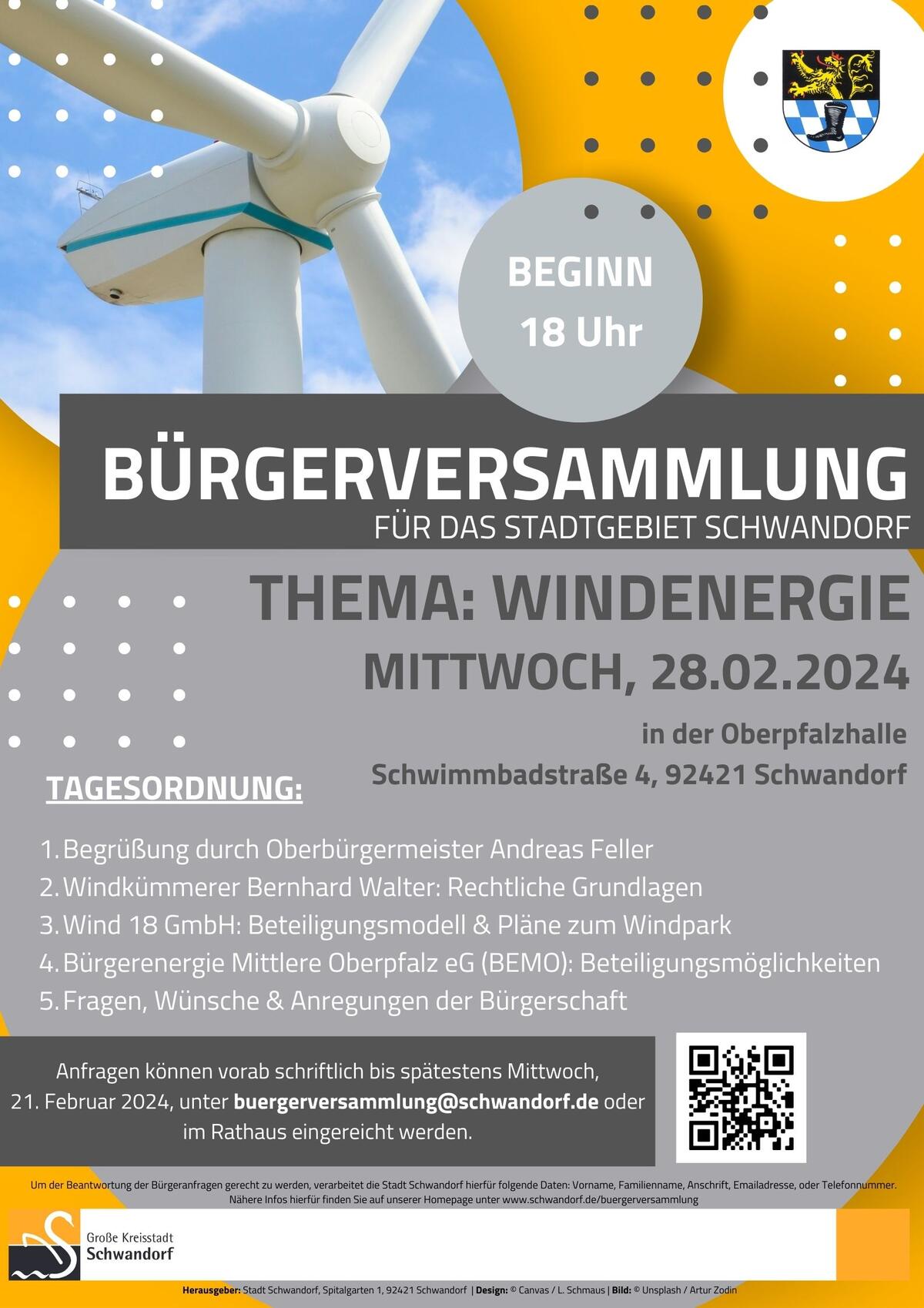 Design: © Canvas / L. Schmaus | Bild: © Unsplash / Artur Zodin © Design: Canvas / L. Schmaus | Bild: Unsplash / Artur Zodin
Für das Stadtgebiet Schwandorf findet am Mittwoch, den 28. Februar 2024 um 18.00 Uhr eine Bürgerversammlung in der Oberpfalzhalle Schwandorf, Schwimmbadstraße 4, 92421 Schwandorf statt.
Thema der Bürgerversammlung ist die Entwicklung der Windenergie im Stadtgebiet.
Es wurde folgende Tagesordnung festgelegt:
- Einleitende Worte von Oberbürgermeister Andreas Feller
- Präsentation von Windkümmerer Bernhard Walter: Rechtliche Grundlagen
- Präsentation von der Wind 18 GmbH: Beteiligungsmodell und Pläne zum Windpark
- Bürgerenergie Mittlere Oberpfalz eG (BEMO): Beteiligungsmöglichkeiten
- Fragen, Wünsche und Anregungen der Bürgerschaft
Klimaabende in Schwandorf - Juni/Juli 2023
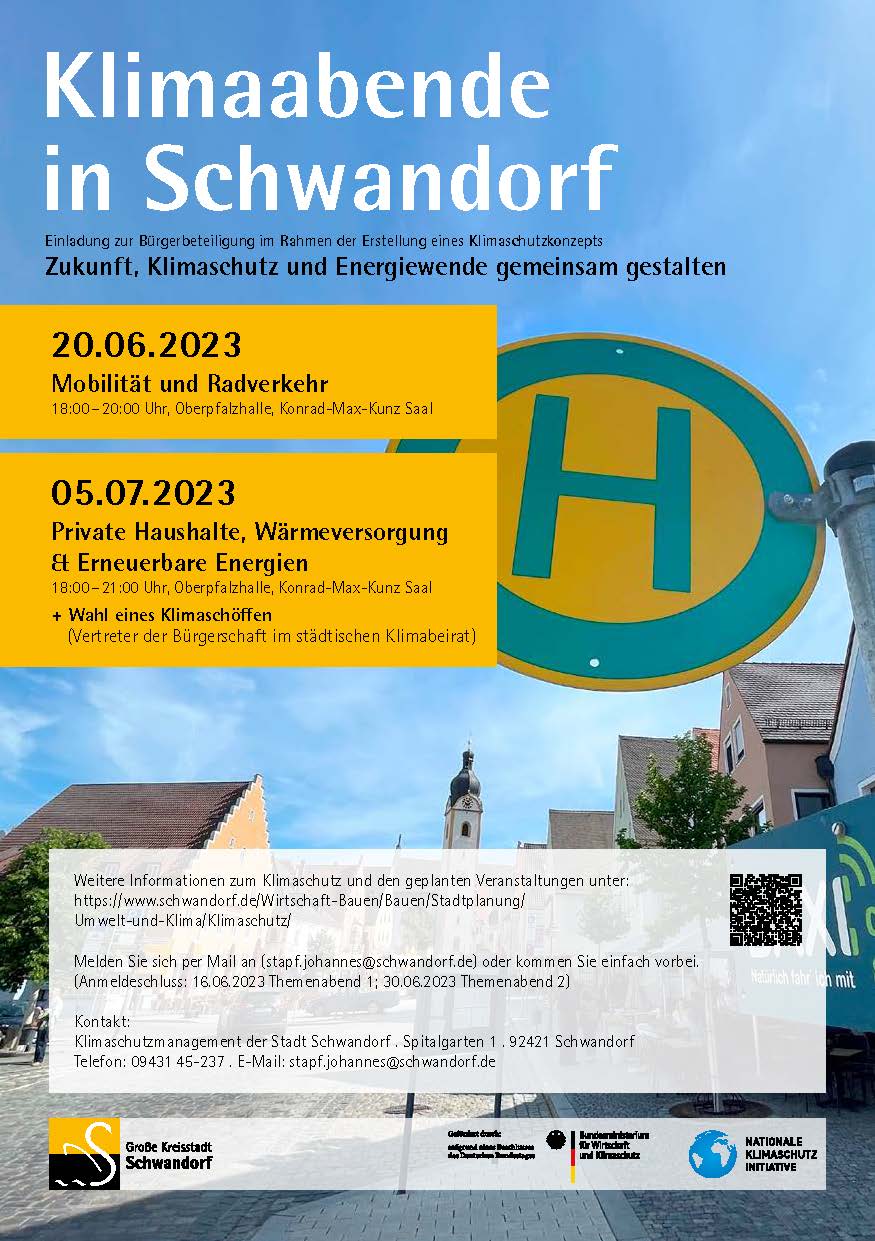
Unter dem Motto „Zukunft, Klimaschutz und Energiewende gemeinsam gestalten“ freut sich die Stadt Schwandorf darauf, die Bürgerschaft aktiv bei der Gestaltung des Klimaschutzes und der Verkehrswende zu beteiligen.
Passend zum diesjährigen Stadtradeln beschäftigt sich ein erster Bürgerabend mit dem Thema „Mobilitätsangebots und Radverkehr“ in Schwandorf, wobei gemeinsam Probleme und Ansätze angesprochen und Lösungen erarbeitet werden können.
 de-agentur © Stadt Schwandorf
„Mobilität und Radverkehr“
20.06.2023 18:00 - 20:00 Uhr, Oberpfalzhalle, Konrad-Max-Kunz Saal
Um Anmeldung wird gebeten, per Mail an: stapf.johannes@schwandorf.de
bis 16.06.2023 Themenabend 1
Beim zweiten Termin zum Thema „Private Haushalte, Wärmeversorgung und erneuerbare Energien“ findet zusätzlich die Wahl der bürgerlichen Vertreter im neu zu gründenden städtischen Klimabeirat statt.
„Private Haushalte, Wärmeversorgung & Erneuerbare Energien“
+ Wahl eines Klimaschöffen (Vertreter der Bürgerschaft im städtischen Klimabeirat)
05.07.2023 18:00 - 21:00 Uhr, Oberpfalzhalle, Konrad-Max-Kunz Saal
Um Anmeldung wird gebeten, per Mail an: stapf.johannes@schwandorf.de
bis 30.06.2023 Themenabend 2
Oder einfach vorbeikommen!
Summary in English
The City of Schwandorf is actively implementing its climate protection and sustainability strategy to address the challenges of climate change at the local level. The targets are set to reduce greenhouse gas emissions, improve energy efficiency, and expand the use of renewable energy while ensuring a high quality of life for its residents.
A key foundation for these efforts is the integrated climate protection concept (Klimaschutzkonzept), adopted in 2023. It provides a comprehensive analysis of energy consumption and emissions in Schwandorf, identifies local potentials, and defines concrete measures across sectors such as buildings, energy supply, mobility, municipal infrastructure, and others. The implementation of these measures is carried out step by step and supported by ongoing monitoring of climate management.
Schwandorf is also addressing the impacts of climate change through climate adaptation measures. Urban planning increasingly considers heat reduction, preservation and expansion of green spaces, and improved water management to respond to heavy rainfall and drought. A central component of the city strategy provides a long-term guidance for sustainable growth and focuses particularly on the energy system transformation. Two key elements of this transformation are the heat transition (Wärmewende) and the broader energy transition (Energiewende), which contribute to resilient living in the city.
Looking ahead, the city is focusing on reducing emissions from building heating, which represents a significant share of overall energy consumption. A central element is the ongoing municipal heat planning process (kommunale Wärmeplanung), which analyzes the current heat supply and identifies future options such as district heating networks and decentralized renewable heating solutions. Municipal heat planning is designed as a strategic planning tool. It does not impose direct obligations on individual households but provides guidance for future investments, infrastructure development, and decision-making by the municipality, energy providers, businesses, and residents.
In addition, the energy transition in Schwandorf includes expanding renewable electricity generation, particularly through photovoltaic systems, and improving overall energy efficiency. Through integrated planning, long-term strategies, and cooperation between public authorities, businesses, and citizens, the city seeks to contribute to global climate goals while ensuring sustainable local development.
Weiterführende Informationen und Links
Entwicklung des Fernwärmenetzes bis 2028
Erweiterungsplanungen der städtischen Fernwärmeversorgung (www.swf-sad.de) bis in das Jahr 2028 (Planungskarte)
- (2.5 MB)
Allgemeine Informationen zur kommunalen Wärmeplanung
www.bundesregierung.de/breg-de/aktuelles/waermeplanungsgesetz-2213692
Allgemeine Informationen zum neuen Gesetz für Erneuerbares Heizen (GEG)
www.bundesregierung.de/breg-de/aktuelles/neues-gebaeudeenergiegesetz-2184942
Solarkataster des Landkreis Schwandorf
Ermitteln Sie für ihr Eigenheim oder gewerbliche Dachfläche, die Potenziale, Eignung und Wirtschaftlichkeit von Photovoltaik, Batteriespeichern und Solarthermie
www.solare-stadt.de/landkreis-schwandorf/spk
Energiemonitor Schwandorf
Aktuelle Daten zu Stromverbrauch und -einspeisung in Schwandorf, bereitgestellt durch die Bayernwerk AG.
Schwandorf: 100% Eigenversorgung · CO2-Einsparungen heute: 53 t · EnergieMonitor 9.4.0 (bayernwerk.de)
Energieatlas Bayern
Übersicht über die vorhandenen Energieerzeugungsanlagen in Schwandorf und weiterführende informative Karten zu verschiedenen erneuerbaren Energien und Erzeugungsanlagen
Energie-Atlas Bayern - Kartenteil
Wattbewerb
Vergleichen Sie die Ausbaugeschwindigkeit von Schwandorf im Bereich Photovoltaik mit anderen Städten und Gemeinden
Wattbewerb - Spielplattform
Bayerisches Klimainformationssystem
Umfassende Informationen zu beobachteten und prognostizierten Klimaveränderungen in Bayern
Startseite | BayKIS (bayern.de)
Bayerisches Klimaschutzgesetz
BayKlimaG: Bayerisches Klimaschutzgesetz (BayKlimaG) Vom 23. November 2020 (GVBl. S. 598, 656) BayRS 2129-5-1-U (Art. 1-14) - Bürgerservice (gesetze-bayern.de)
Moorbodenkarte
Verteilung von moorartigen Böden in Schwandorf
www.umweltatlas.bayern.de/mapapps/resources/apps/umweltatlas/index.html?lang=de&stateId=8b59a321-d05b-4e82-99a3-21d05bce828f
Weiterführende Literatur
Klimaschutz in Zahlen (2022), Aktuelle Emissionstrends und Klimaschutzmaßnahmen in Deutschland, Bundesministerium für Wirtschaft und Klimaschutz
BMWK - Klimaschutz in Zahlen (2022)
Archiv
-
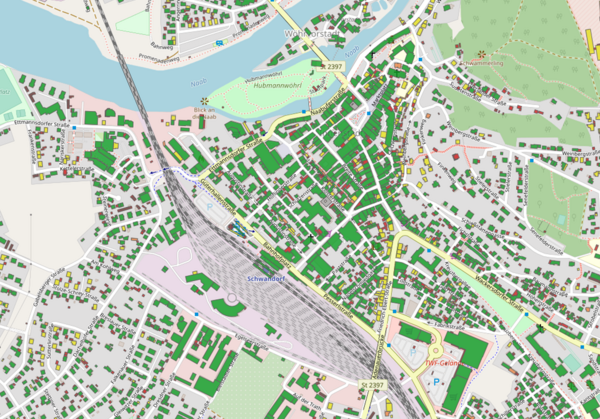 © Landkreis Schwandorf
Solarkataster für den Landkreis Schwandorf ist online
Im Rahmen des Energienutzungsplanes des Landkreises Schwandorf wurde ein Solarkataster für den Landkreis Schwandorf entwickelt. Mehr
-
 © Wattbewerb
Schwandorf nimmt am »Wattbewerb« teil
Seit Ende letzten Jahres nimmt Schwandorf am „Wattbewerb“ teil. Mehr
 © Bundesministerium für Umwelt, Klimaschutz, Naturschutz und nukleare Sicherheit